Naturalists Register Weekly Entries
A gentle meander through the garden today reveals nature’s quiet wisdom. Join me as we observe the subtle rhythms, seasonal shifts, & botanical curiosities that remind us to slow down & notice the extraordinary in the ordinary.
field Notes
Weekly observations
Natural Indicators
Bird Activity
In November in Everton Hills, Brisbane, the warm weather brings a peak in bird activity, with resident species in the midst of their breeding season and migratory birds continuing to nest and raise young. The area’s parks and gardens, particularly Teralba Park, are excellent for observing this vibrant wildlife.
Notable Species This Week
Resident Birds
Pied Butcherbird
The breeding season for these talented songbirds continues in November, so listen for their musical calls and be mindful of potential swooping.
Rainbow Lorikeet & Scaly-breasted Lorikeet
Noisy flocks of these colourful parrots are very active, breeding and feeding on nectar from flowering trees.
Migratory residents
Fork-tailed Swift
This non-breeding migrant arrives in northern Australia around November, only a few were sighted in the Brisbane skies.
Pacific Koel (Common Koel)
The loud, repetitive calls of the male koel are common during November, as they are breeding in south-east Queensland.
Ground-dwelling birds
Bush Stone-curlew
Although less common in the suburbs than other ground-dwelling birds, they can be found in remnant bushland and reserves. They are most active at night and have a distinctive wailing call.
Bats & other nocturnal fauna
Microbats
Everton Hills is also home to various microbat species, which are insectivorous.
Common species include Gould’s wattled bat and the little bent-wing bat, which are active during the night.
Little Red Flying-fox
This nomadic species can also be present in the area during the warmer months.
Insect Presence
Common Insects & Their Activity
In November in Everton Hills, Brisbane, the warm, humid weather of summer brings a peak in insect activity. Resident species are in the middle of their breeding season, and migratory species are active in the area. Abundant rainfall, common at this time of year, can also trigger population blooms and swarming events.
Notable Species This Week
beetles
Christmas Beetles (Anoplognathus spp.)
These iconic, iridescent beetles begin to emerge from the ground around mid-November, especially after rain.
Feeding: Adults feed on the foliage of eucalypt trees, while larvae (curl grubs) feed on grass roots.
ants
Common Ants
Ants like the Coastal Brown Ant (Pheidole megacephala) and Black House Ant(Ochetellus glaber) are active and may invade homes.
bees & wasps
Mud Dauber Wasp (Sceliphron sp.)
These solitary wasps are active, provisioning their mud nests with spiders for their young.
other bugs
Spiders
Spiders become more visible and active as they hunt for the plentiful insect population. This includes the St Andrews Cross spider(Argiope keyserlingi) and the Redback spider(Latrodectus hasseltii).
Cicadas
November is the peak season for many species of cicadas, whose loud buzzing is a characteristic sound of summer.
Plant Responses
In November in Everton Hills, Brisbane, the warm and humid conditions of summer continue to drive strong plant growth and flowering, and plants respond with vigorous growth, and many are in full bloom or producing fruit. This is also a peak time for many insects, with many feeding on the abundant nectar and foliage.
Notable Species This Week
Wild & suburban native plants
Trees & large shrubs
Lilly Pilly (Syzygium spp.)
Common in suburban gardens, lilly pillies will be actively growing and may be flowering or producing berries, which attract native birds.
Grevillea (Grevillea spp.)
Various species of grevillea, especially those that flower through summer, will be in bloom, attracting nectar-feeding birds and insects.
Groundcovers & smaller plants
Native Hibiscus (Hibiscus spp.)
Many species of native hibiscus will be flowering, providing food for native bees.
Nectar from the flowers attracts pollinators like carpenter bees.
Suburban garden plants & seasonal responses
Ornamental plants
Bougainvillea (Bougainvillea spp.)
This colourful climber thrives in Brisbane’s warm weather and will be in full bloom in November.
Edible plants
Month Long Home Garden Planting
- Tomatoes
- Capsicums
- Eggplants
- Sweet corn
- Cucumbers
- Pumpkin
- Zucchini
- Some heat-tolerant lettuce varieties can be planted.
November ideas for begginer gardeners
Basil (Ocimum basilicum)
Thrives in the warm weather and can be grown easily in January.
Chillies (Capsicum spp.)
Can be sown during January. It will be actively growing & fruiting during the summer heat.
Lemongrass (Cymbopogon spp.)
Easily sown & grows vigorously during the humid summer.
Mangoes (Mangifera indica)
Flowering occurs between September and November in subtropical regions.
Botanical Study
plant Foraging
Each weekly plant can reasonably be expected to forage in Everton Hills, Brisbane, QLD in January.
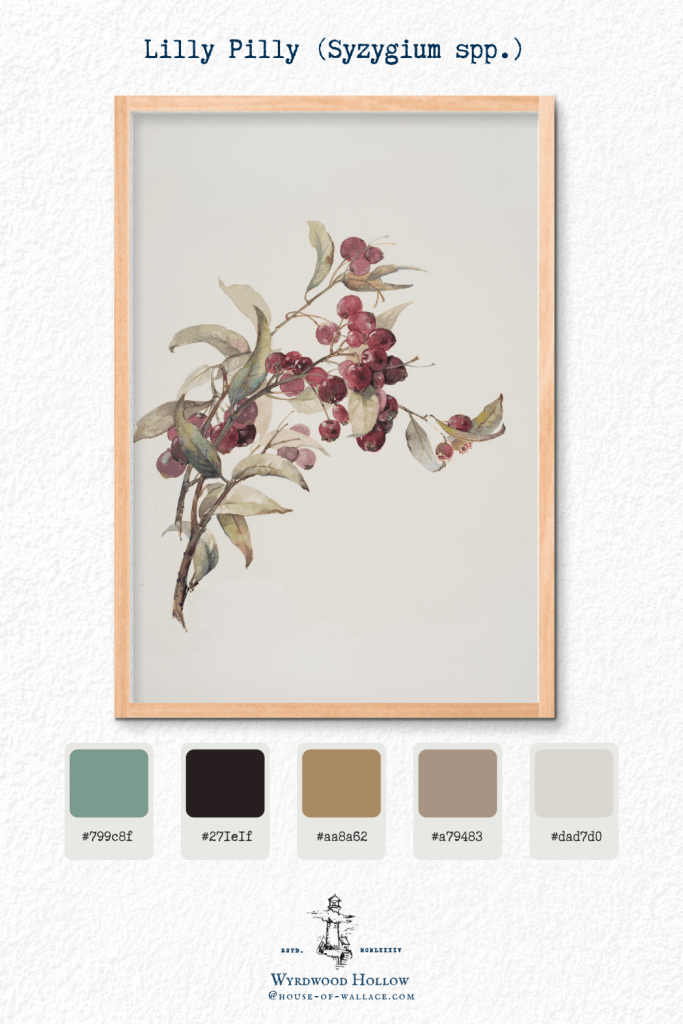
Lilly Pilly (Syzygium spp.)
foraging Species This Week
Lilly Pilly (Syzygium spp.)
Acacia leiocalyx or Acacia sophorae (native wattles with edible components)
Plant name: Lilly pilly, brush cherry, riberry
Latin name: Syzygium spp.
(examples: S. smithii, S. australe and numerous cultivars)
Growth Stage November
Peak fruiting for many cultivars; ripe berries commonly present on hedges and sheltered plants.
Notable Features
Extremely common as hedging and street planting; fruits are favoured by birds and often found in suburban hedges.
Eaten fresh or cooked; widely used in jams, relishes, cordials and contemporary cuisine.
Identification key
- Evergreen shrub or small tree with glossy opposite leaves
- Clusters of small white brush‑flowers in spring
- Fleshy berries that vary from white/pink to red or deep purple depending on species/cultivar.
Urban Foraging
- Check street hedges
- Parks
- Council plantings
- Private gardens (ask permission) for accessible fruit
Sustainability
- Harvest lightly across multiple plants
- Leave plenty for birds and pollinators to ensure seed dispersal and ongoing plant health
Harvesting notes
- Pick fully coloured, slightly soft berries
- Collect into a container and wash before use
Fruiting
- Main fruiting spring → autumn
- November typically has abundant ripe fruit on many cultivars
Flavour
- Tart to sweet‑tart
- Some cultivars are best cooked to reduce astringency.
Smell
- Mild fruity aroma
- Crushed leaves give a faint peppery/citrus scent.
Optimal Sunlight
- Full sun to part shade.
Check for safety
- Confirm Syzygium identification
- Avoid fruit from plants recently treated with pesticides or exposed to heavy vehicle pollution.
Note
- Birds often feed heavily on fruit
- Avoid plants with heavy droppings and leave most fruit for wildlife
Processing
- Excellent for jams, relishes, syrups and baked goods
- Many people cook lilly pilly to concentrate flavour
Species
- The genus is native to Australia; many urban hedges are cultivated varieties.
Where to look for them
- Street hedges
- Suburban parks
- Riparian gardens
- Private hedges
Responsible Harvesting
- Limit harvest to about 20–30% of one plant’s crop
- Only pick fully coloured, ripe berries.
FIELD SKETCH
Weather & Observations
Weekly Weather Field Notes
Weather Notes
Weekly Weather Tracker
| Date | Clouds | Wind | Pressure | Sunrise | Sunset | Moonrise | Daylight | Emotional Weather |
|---|---|---|---|---|---|---|---|---|
| 26 Oct | High cirrus | Gentle southerly | 1012 hPa | 6:12 AM | 7:23 PM | 8:45 PM | 13h 11m | Luminous, porous |
Weekly Summary
This week began with warm winds and ended in soft drizzle. Cloud formations echoed internal shifts.
Note: Climatological averages provide typical weather patterns based on historical data, offering reliable general guidance rather than exact forecasts. Cloud types and wind directions can be described broadly, reflecting common occurrences rather than daily specifics. Barometric pressure averages indicate general weather tendencies but not precise changes. Precipitation values represent average amounts and frequency, acknowledging actual rainfall can vary significantly from these norms. This approach is ideal for understanding usual conditions over time, not for detailed short-term predictions.
Field sketch





You must be logged in to post a comment.