
FRONTISPIECE
Garden Plats: A Chronicle of Cultivated Spaces Across Continents
The garden plat, in days gone by, served not merely as a blueprint for cultivation, but as an eloquent testament to man’s dominion over nature. These intricate plans, meticulously drafted, functioned as both practical guides for the horticulturalist and artistic representations of a desired Eden. Through the study of these historical garden plats, we can glean insights into the practices, aspirations, and ecological understandings of bygone eras, across diverse landscapes from the Old World to the New.
Historical Garden plats of Note
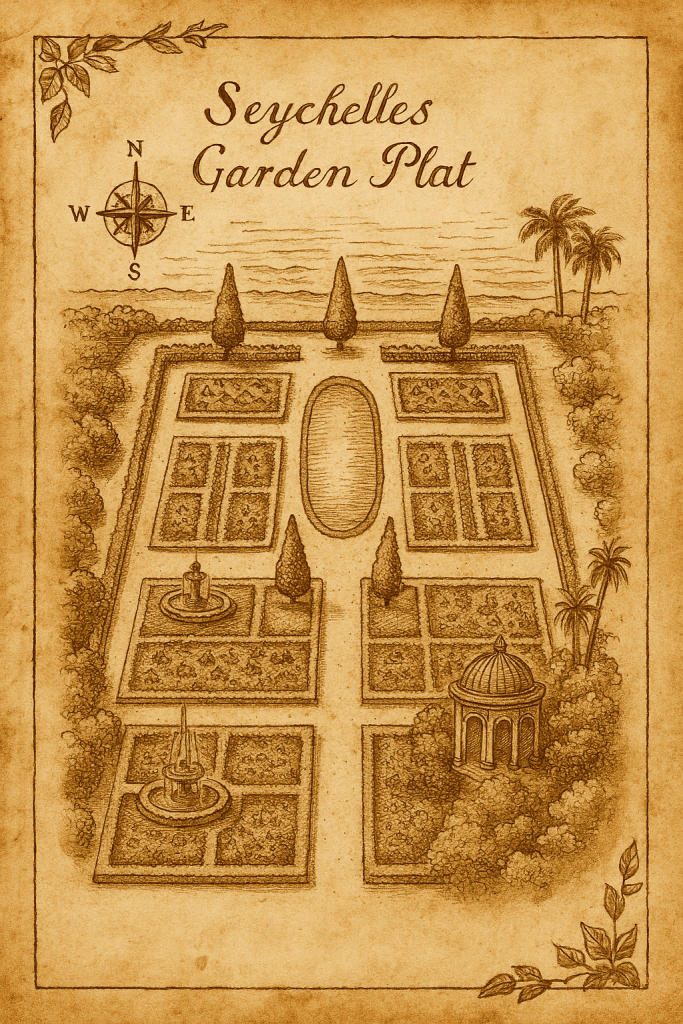
Contemplation of the Seychelles Garden
In ages past, before the advent of modern cartography and the ubiquity of digital imagery, garden plats served as vital instruments.
More than mere blueprints, they were artistic renderings interwoven with practical knowledge, a testament to the gardener’s aspirations and understanding of the natural world.
These plats, often meticulously hand-drawn and coloured, guided the establishment and maintenance of cultivated spaces, offering invaluable insights into the horticultural practices of the period.
This article delves into the garden plats of the Seychelles, exploring their evolution before and after colonisation, shedding light on the botanical and architectural considerations that shaped these verdant landscapes.

Significant Features & History
Prior to European influence, the Seychelles archipelago, a jewel in the Indian Ocean, harboured unique garden plats, borne not of formal design but of necessity and adaptation.
These pre-colonial gardens were primarily subsistence-focused, each a carefully delineated space carved from the dense, humid forests. Local inhabitants, intimately connected to the land, cultivated crops like yams, cassava, and coconuts.
Their ‘plats,’ more mental maps than drawn documents, prioritised maximal yield within the challenging tropical environment. Knowledge of soil composition, rainfall patterns, and the specific requirements of each plant was passed down through generations, informing the selection of planting locations and the arrangement of crops.
The arrival of European colonisers, primarily the French and later the British, irrevocably altered the landscape and, consequently, the nature of garden plats.
The introduction of plantation agriculture, with its focus on cash crops such as cloves, cinnamon, and vanilla, led to the development of more formal garden designs.
These post-colonial plats reflected the European aesthetic, adopting elements of symmetry, order, and geometric precision favoured during the Enlightenment.
Detailed surveys were conducted, and plats were drawn on parchment, meticulously documenting the layout of these expansive estates.
Provenance & Notable Attributes
Finding accurate pre-colonisation representations is almost impossible. Their garden knowledge was passed through oral traditions and practical experience as physical representations would be impermanent.
Post-colonisation plats, the provenance of which included the French and British East India Companies, were quite different.
Elaborate estates were often designed in the style of French formal gardens with allées, parterres, and water features, albeit adapted to the tropical climate.
A notable characteristic of these plats was their meticulous detail. Each tree, shrub, and flowerbed was precisely located and labelled.
The plats also included detailed notes on soil conditions, irrigation systems, and drainage channels, reflecting a growing understanding of the scientific principles underlying horticulture.
Compass Orientations & Boundaries
The orientation of these gardens was carefully considered, acknowledging the path of the sun and the prevailing winds.
In the pre-colonial era, the orientation was primarily dictated by the terrain and accessibility to water sources.
Post-colonisation plats often favoured an east-west orientation to maximise sunlight exposure across the gardens throughout the day.
Boundaries were clearly defined, either by hedges, walls, or paths, reflecting the European emphasis on order and control.
Particulars of Measure in Historical Units
The pre-colonisation plats used local measurements, defined by body parts and distances.
Post-colonisation, the plats began to use a mix of French ‘pieds’ (approximately 30 centimetres, or 11.8 inches) and later British ‘feet’ (approximately 30.5 centimetres, or 12 inches) and ‘yards’ (approximately 0.91 metres, or 3 feet).
Larger estates were measured in ‘arpents’ (approximately 0.84 acres, or 3400 square meters) under French rule, eventually replaced by acres under British governance.
Smaller features, such as flowerbeds and pathways, were often measured in feet and inches.
The plats would record the dimensions of key features, such as the length of allées (often several hundred feet), the diameter of fountains (perhaps ten to twenty feet), and the width of pathways (typically four to six feet).
Observations on Seasonal Change
The Seychelles experiences a tropical climate with two distinct seasons: the southeast trade winds season (May to October) and the northwest monsoon season (November to April).
Garden plats often included notes on the impact of these seasonal changes on plant growth. During the southeast trade winds, the climate is relatively dry and cool, with temperatures averaging around 27°C (81°F). The northeast monsoon season, by contrast, brings increased rainfall and humidity, with temperatures rising to around 30°C (86°F).
The plats were useful for tracking the flowering and fruiting of plants throughout the year, noting that certain species thrived during the dry season while others flourished in the wetter months.
Such observations were invaluable for planning planting schedules and managing the garden’s resources.
Notes on Successful or Failed Plantings
The historical garden plats also served as a repository of horticultural knowledge, documenting the success or failure of specific plantings.
The gardener would record the species planted, the date of planting, the type of soil used, and details of the irrigation and fertilisation treatments.
Observations on plant growth, flowering, and fruiting were also noted, along with any problems encountered, such as pests, diseases, or nutrient deficiencies.
These notes served as a valuable resource for future gardeners, allowing them to learn from past successes and avoid repeating past mistakes. They also provided insights into the suitability of different plants for the Seychelles climate and soil conditions.
Weather Records Relevant to the Garden’s Performance
Weather records were an integral part of historical garden plats, providing context for the observations on plant growth and performance.
Rainfall data was meticulously recorded, often using a rain gauge to measure the amount of precipitation received each day.
Temperature readings were also taken, usually using a mercury thermometer, and the plats would note the daily maximum and minimum temperatures.
Wind direction and speed were also recorded, providing information on the prevalence of the southeast trade winds and the northwest monsoons.
These weather records helped the gardener understand the impact of climate on plant growth and make informed decisions about irrigation, fertilisation, and pest control.
They also provided a historical record of the climate in the Seychelles and its potential impact on agriculture.
References to Historical Gardening Texts that Influenced the Design
The design of post-colonial garden plats in the Seychelles was influenced by a variety of historical gardening texts and traditions.
French formal gardens, exemplified by the gardens of Versailles, provided a template for the layout and design of large estates.
Books on botany and horticulture, such as Carl Linnaeus’s Species Plantarum, provided information on the classification and cultivation of plants.
British gardening traditions also played a role, particularly in the design of smaller gardens and kitchen gardens.
Books on practical gardening, such as the Gardener’s Calendar by Philip Miller, provided advice on the cultivation of vegetables, fruits, and flowers.

Marginalia

Personal Reflections on the Garden’s Development –
Beyond the scientific and practical aspects, historical garden plats often contained personal reflections on the development of the garden.
The gardener would express their aesthetic preferences, describe their challenges and successes, and share their hopes for the future of the garden.
These personal reflections offer a glimpse into the human side of gardening, revealing the passion, dedication, and creativity that went into creating these beautiful and productive spaces.
They also provide insights into the social and cultural context in which the gardens were created, reflecting the values and aspirations of the people who designed and maintained them.
The garden plats of the Seychelles, both pre and post-colonisation, stand as silent witnesses to the island’s rich horticultural heritage.
They offer a valuable perspective on the evolution of gardening practices in the region, reflecting the influence of local traditions, European aesthetics, and scientific advancements.
By studying these plats, we can gain a deeper understanding of the history, culture, and environment of the Seychelles and appreciate the enduring importance of gardens in our lives.



Leave a Reply